Silent historical epic · 1927 · France
Napoléon 1927
Directed by Abel Gance. Known in English as Napoleon.
- DirectorAbel Gance
- Running timec. 5.5 hours
- CountryFrance
- Decade1920s
Review by Eleanor Hale
Napoléon is Abel Gance's 1927 silent epic about the young Bonaparte, from a snowball fight at the military school of Brienne to the start of the Italian campaign in 1796. It was planned as the first of six films covering his whole life. Only this one was made. It is long, uneven and politically naive, and it is also one of the most inventive films of the silent era. Gance threw the camera around as no one had before: strapped to a horse, swung on a pendulum over a crowd, cut in shots that last a few frames. The finale spreads across three screens side by side, a process called Polyvision that was used for no other film. If you care about what cinema could do before sound, this is the film to see.
The story it tells
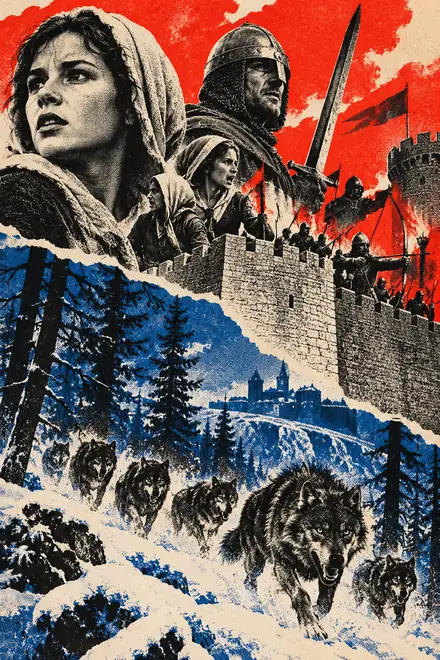
The film opens in winter at Brienne-le-Château. The schoolboy Napoleon, mocked by the other pupils, organises a snowball fight as if it were a battle and wins it. Ten years later he is a young artillery officer on the edges of the Revolution. We see the Cordeliers club, Rouget de Lisle teaching the crowd the Marseillaise, Danton, Marat and Robespierre. Napoleon goes home to Corsica, falls out with the island's leader Pasquale Paoli and escapes by sea in a small boat, using a French flag as a sail, while a storm in the Convention is cut against the storm at sea.
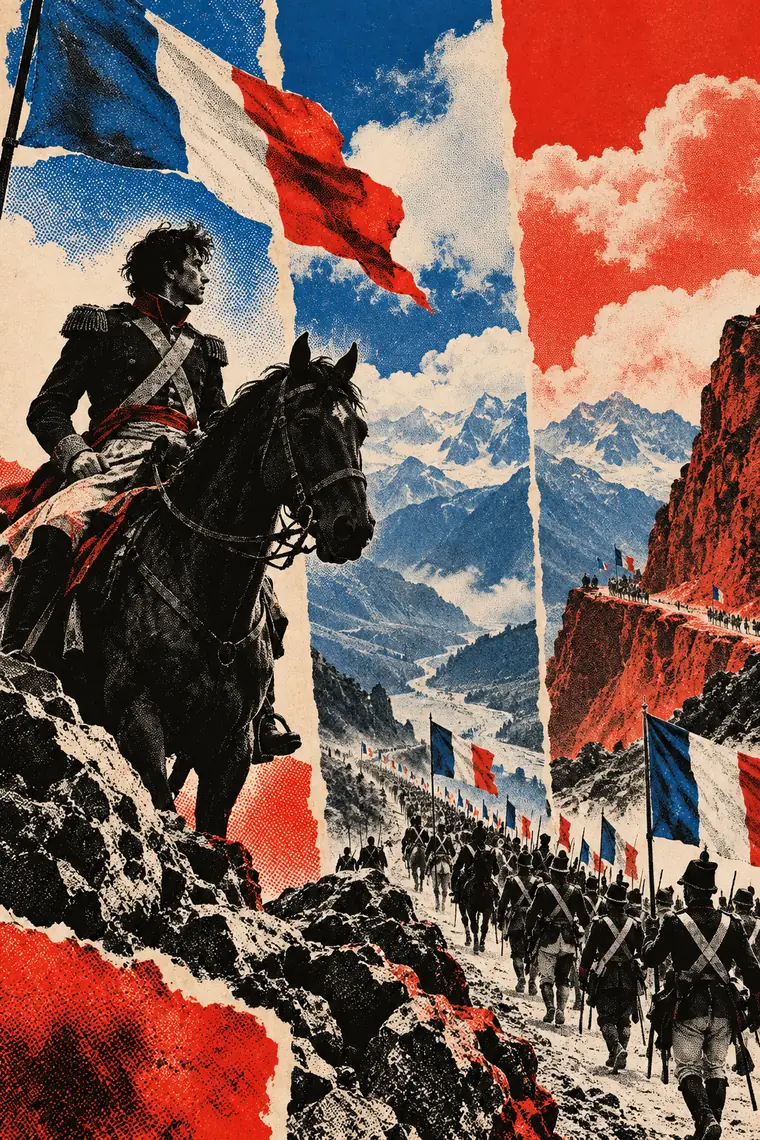
He returns to take part in the siege of Toulon, survives the Terror, meets Joséphine de Beauharnais and marries her. The last section shows him taking command of the half-starved Army of Italy and leading it across the Alps. That is where the screen opens into three.
How Gance shot it
Gance and his cinematographer Jules Kruger worked with a mobile camera at a time when most shots were taken from a fixed tripod. For the snowball fight the camera is thrown into the action. For the Convention sequence it swings above the deputies like a pendulum. Some shots superimpose up to sixteen images. The cutting gets faster and faster at moments of excitement, until single frames flash past.
The triptych at the end was filmed with three cameras stacked together. Sometimes the three panels form one wide panorama of the army; sometimes Gance puts different images side by side, with Napoleon's face in the centre and marching troops on either side, so the screen works like a page of a comic or a stained-glass window.
Albert Dieudonné plays Bonaparte with a fixed stare and a hand often kept inside his coat. The surrealist poet and playwright Antonin Artaud is Marat, and Gance himself plays Saint-Just.
A film that kept changing length
Napoléon premiered at the Paris Opéra on 7 April 1927 in a shortened version with the triptych. A longer cut ran later that year. Then the film was cut down, sound was added in a 1935 version, and for decades no one saw it as Gance had made it.
The film historian Kevin Brownlow spent much of his life collecting surviving prints and fragments. His restorations, shown with live orchestra from 1979 and in a famous 1981 American tour with a score by Carmine Coppola, brought the film back to an audience. In 2024 the Cinémathèque française presented a new restoration of more than seven hours, assembled from the original negatives, with a new score.
What still works, and what does not
The energy of the film still astonishes. The snowball fight, the Convention sequence and the Alpine finale feel alive in a way that many later epics do not.
The weak point is the hero himself. Gance treats Napoleon as a man of destiny, almost a saint, and the film has no interest in what his ambition cost France and Europe. The intertitles can be overblown. Some of the domestic scenes, especially the courtship of Joséphine, drag.
See it for the form, not for the history lesson.
Where it sits in French cinema
Gance had already made J'accuse (1919) and La Roue (1923), two films that influenced the Soviet montage directors. Napoléon is the summit of the 1920s French avant-garde, alongside Marcel L'Herbier's L'Argent and the work of Jean Epstein. Its revival in the 1950s mattered to the young critics who became the New Wave. For more films from the same period, see our guide to the best French films of the 1920s.