Silent historical epic · 1924 · France
Le Miracle des loups 1924
Directed by Raymond Bernard. Known in English as The Miracle of the Wolves.
- DirectorRaymond Bernard
- Running timec. 130 min
- CountryFrance
- Decade1920s
Review by Eleanor Hale
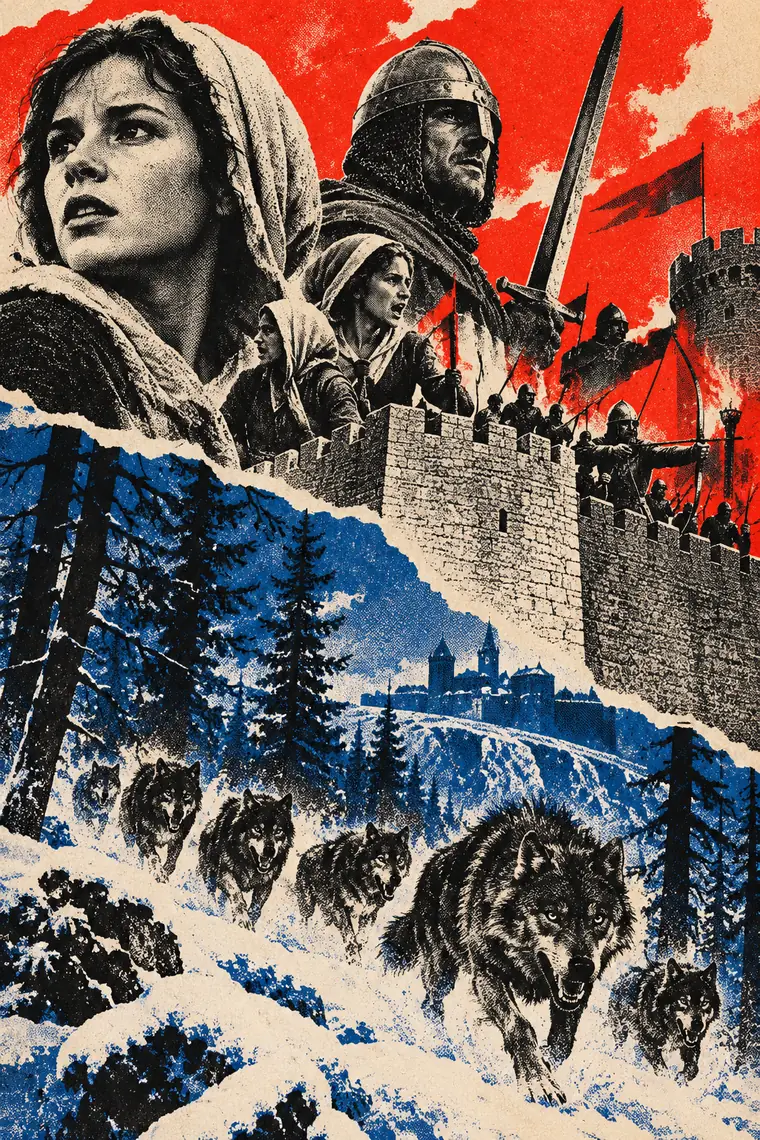
Le Miracle des loups (The Miracle of the Wolves) is Raymond Bernard's 1924 silent epic about the struggle between King Louis XI of France and Charles the Bold, Duke of Burgundy, in the 15th century. It was one of the most expensive French films of its time, with crowd scenes shot at the medieval walled city of Carcassonne and at the Château de Pierrefonds, and it was hailed as a French answer to D. W. Griffith's The Birth of a Nation. Its premiere at the Paris Opéra was attended by the President of the Republic. Charles Dullin, one of the great stage actors of the period, plays a sly, calculating Louis XI. The title refers to a scene in which wolves attack the king's enemies in a snowy forest.
The story
The film is set at the time when Louis XI was patiently piecing together the kingdom of France, while the powerful Duke of Burgundy, Charles the Bold, wanted to break him. At its centre are Jeanne Fouquet, a young woman loyal to the king, played by Yvonne Sergyl, and the knight Robert Cottereau, played by Romuald Joubé.
The story mixes court intrigue with history and builds to the siege of Beauvais, where Jeanne, remembered by history as Jeanne Hachette, leads the defence of the town against the Burgundian army until reinforcements arrive. The miracle of the title is a scene in a snowy forest in which wolves attack the king's enemies.
A film of spectacle
Bernard and his producers, the Société des Films Historiques, set out to make a national epic. The battle and siege scenes, filmed on the real ramparts of Carcassonne with thousands of extras, still impress. Other scenes were shot in the mountains around Grenoble, at Le Sappey-en-Chartreuse and the Col de Porte, which gave the film winter landscapes rarely seen in French cinema of the time.
The sets were designed by the architect Robert Mallet-Stevens with Jean Perrier, and the costumes were drawn by the illustrator Job. The composer Henri Rabaud wrote a full orchestral score for the premiere.
Dullin's Louis XI
Charles Dullin, who ran the Théâtre de l'Atelier in Paris and trained a generation of actors, gives the king a crafty, almost comic intelligence: a small, hunched figure who wins by patience rather than force, set against the bulky, violent Charles the Bold played by the opera singer Vanni-Marcoux. Look out for young actors who became famous later, including Gaston Modot and Albert Préjean.
A nationalist epic
Made a few years after the First World War, the film celebrates the unity of France and the defeat of a foreign-backed enemy in the east, and audiences in 1924 would have understood the echo. It shows a moment of French glory in a heroic, patriotic light. That is part of its historical interest today.
Versions
A sound version was released in 1930. In 1961 André Hunebelle made a new Miracle des loups with Jean Marais, using the same story as a swashbuckler. The 1924 film was later restored, with tinting and a recording of Rabaud's score.
Raymond Bernard went on to make Les Croix de bois (1932) and a celebrated Les Misérables (1934). For other silent spectacles, see Napoléon and our guide to the best French films of the 1920s.