Romantic drama · 1934 · France
L'Atalante 1934
Directed by Jean Vigo.
- DirectorJean Vigo
- Running time85 min
- CountryFrance
- Decade1930s
Review by Eleanor Hale
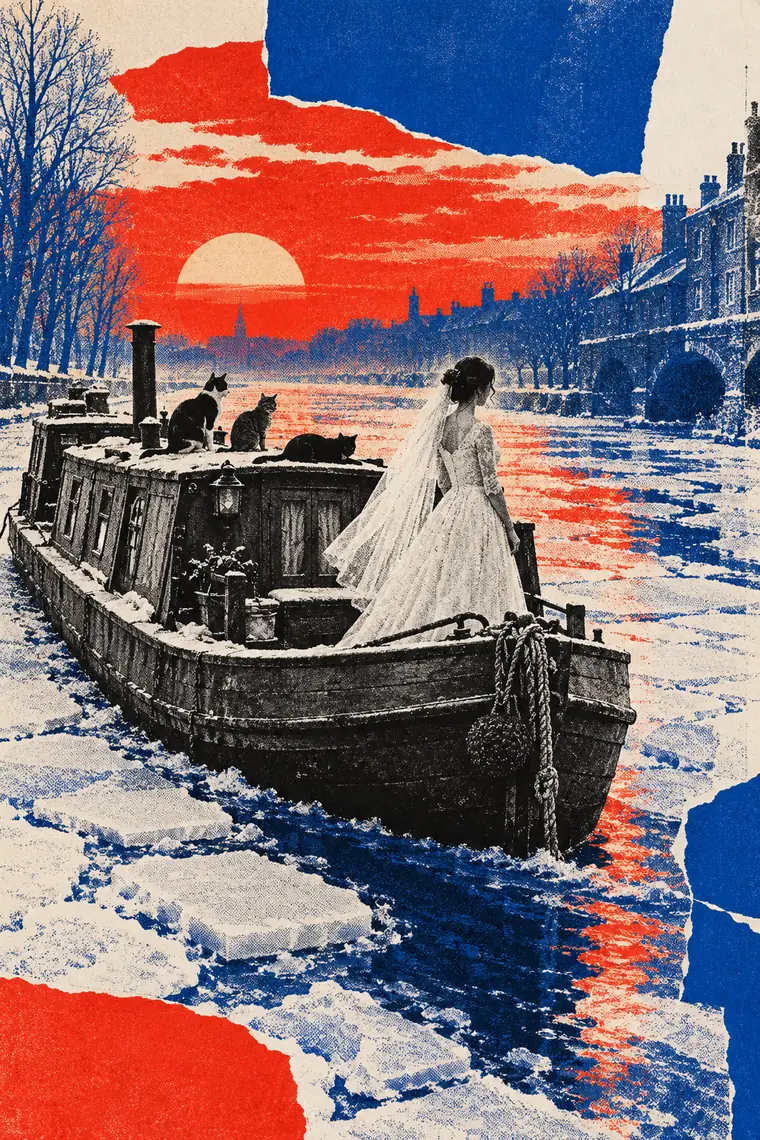
L'Atalante is the only full-length film Jean Vigo made. He shot it in the winter of 1933-34, already ill with tuberculosis, and died in October 1934 at the age of 29, after the distributor Gaumont had cut the film and retitled it. The story fits in a few lines: Jean, the captain of a canal barge, marries Juliette, a village girl, and takes her aboard with his old mate Père Jules and a cabin boy. On the way to Paris she grows restless, slips off to see the city, and the couple are separated. What makes the film last is everything around that plot: the cats all over the boat, Michel Simon's tattooed and grumbling Jules, the frost on the canals, and a love story filmed with real physical longing. Critics' polls still place it among the greatest films ever made.
A wedding, a barge and a city
The film opens on the wedding. There is no feast; the bride walks from the church to the barge in her white dress, followed by a silent procession of villagers, and is swung aboard on a boom. From then on we live on L'Atalante as it moves along the canals towards Paris.
Juliette has never left her village. She is curious about everything, while Jean is jealous and a little dull. Père Jules is the third pole: a sailor who has been everywhere, whose cabin is full of souvenirs, gramophones and kittens, and who shows Juliette his tattoos and a pickled pair of hands in a jar. When a pedlar on a riverside dance floor charms her with stories of Paris, she sneaks away to see it. Jean, furious, sails off without her.
The two scenes everyone remembers
Separated, Jean and Juliette lie in their beds in different places and the film cuts between them, each moving as if touching the other. It is one of the most sensual sequences in 1930s cinema, done with no contact at all.
The second is underwater. Juliette once told Jean that if you open your eyes in water you can see the one you love. Desperate, he dives into the canal, and in the murk her image appears to him in her wedding dress, superimposed and drifting. Boris Kaufman, who had shot Vigo's earlier Zéro de conduite, photographs the scene with a dreamy simplicity.
Michel Simon
Simon was already a star of stage and screen, known for Renoir's La Chienne and Boudu sauvé des eaux. His Père Jules is half ogre, half child: he fights with an imaginary partner, plays the accordion, and eventually goes into Paris to bring Juliette back. Many viewers come away remembering him more than the couple.
What Gaumont did to it
Gaumont found the film too uncommercial. It cut the running time, changed the title to Le Chaland qui passe after a popular song of the day, and inserted that song on the soundtrack. Vigo, bedridden, could not fight back. The film was a failure on release.
Its reputation grew later, through film clubs and the Cinémathèque. Restorations in 1990 and in 2001 tried to bring back Vigo's version, using surviving prints and the original title. The restored film runs close to an hour and a half.
Why it still matters
L'Atalante sits between the realism of 1930s French cinema and the poetry of the surrealists Vigo admired. It shows working life on the water with documentary accuracy, then turns that life into something close to a fairy tale. The New Wave directors, especially François Truffaut, treated Vigo as a patron saint.
If you are new to it, watch the restored version and do not expect a strong plot. Watch it for Dita Parlo's face, for Simon, and for those winter canals. Then continue with our selection of the best French films of the 1930s, the decade that also gave us La Grande Illusion and Le Quai des brumes.