Crime thriller · 1967 · France, Italy
Le Samouraï 1967
Directed by Jean-Pierre Melville.
- DirectorJean-Pierre Melville
- Running time105 min
- CountryFrance, Italy
- Decade1960s
Review by Eleanor Hale
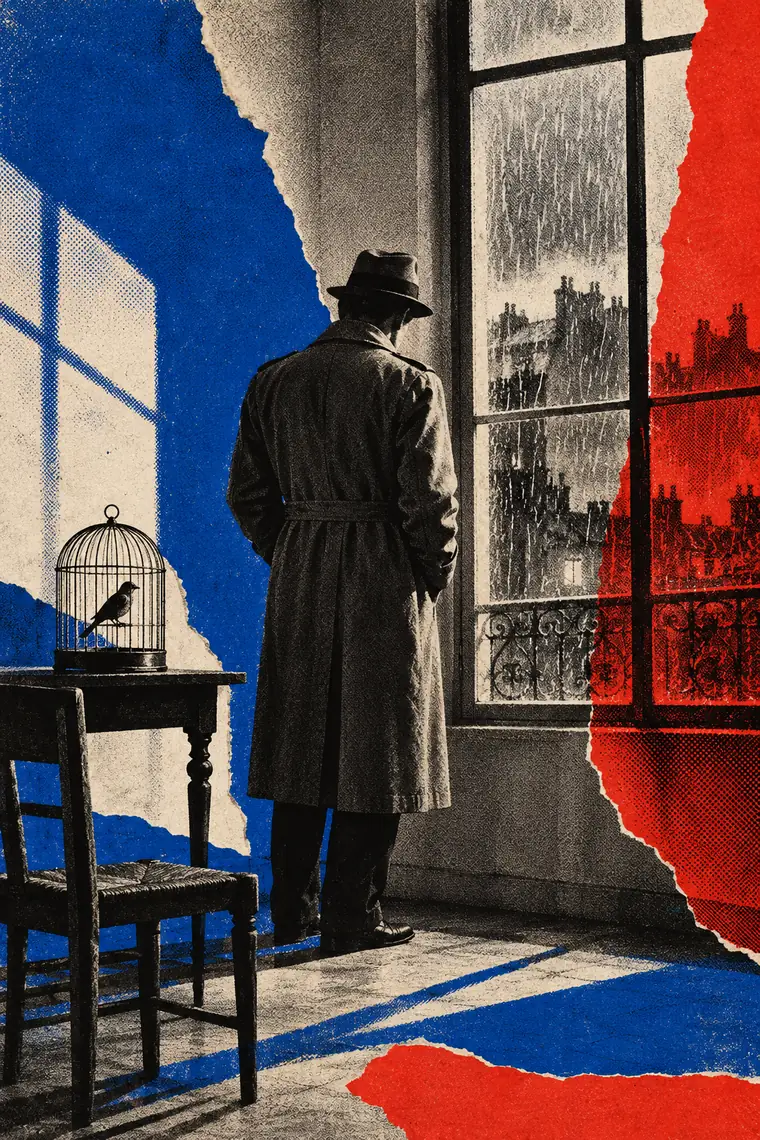
Le Samouraï is Jean-Pierre Melville's 1967 crime film about Jef Costello, a professional killer in Paris played by Alain Delon. He lives alone in a bare room with a caged bullfinch, wears a trench coat and a fedora, speaks as little as possible, and prepares each job like a ritual. After he shoots a nightclub owner, he is seen by several witnesses, including the club's pianist. The police superintendent suspects him; the men who hired him decide he is a risk and try to kill him. For the rest of the film Jef is hunted by both sides through streets, flats and Métro corridors. There is barely any dialogue in the first ten minutes. It is the purest example of Melville's style, and directors from John Woo to Jim Jarmusch have borrowed from it.
Jef Costello
The film opens on Jef lying on his bed in the half-dark, smoking, while the bird chirps. A quotation on screen, attributed to the Bushido, says that there is no greater solitude than that of the samurai, unless it is that of the tiger in the jungle. Melville invented it himself.
Jef steals a Citroën DS by trying keys from a large ring until one fits, has its plates changed at a garage by a man who never asks questions, and builds an alibi with two women: his lover Jane, played by Nathalie Delon, and a group of card players. Then he walks into the nightclub and kills its owner.
Witnesses and an alibi
The police round up dozens of men in trench coats and hats for an identity parade. Some witnesses recognise Jef, others are not sure. The pianist, Valérie, played by Cathy Rosier, looks straight at him and says it is not him. Why she lies becomes one of the threads of the film.
François Périer plays the superintendent, a tired, methodical man who does not believe the alibi and sets a trap. The sequences in which plain-clothes officers follow Jef through the Métro, handing him from one to the next by radio, are among the best chase scenes ever filmed, even though nobody runs.
Melville's world
Melville loved American gangster films and changed his surname, Grumbach, in tribute to the author of Moby-Dick. His Paris is a cold, imaginary city of grey-blue light, rain on windscreens and empty rooms. Henri Decaë drained the colours almost to monochrome. François de Roubaix's music is sparse, mostly organ and a lonely melody.
There is no backstory and very little psychology. Jef's gestures replace explanations: the way he adjusts his hat before leaving, the white gloves he puts on for a job, the money he counts and puts away.
Delon
Delon was 31 and one of the most famous faces in Europe. Melville used his beauty as a mask: Jef's expression barely changes, and the effect is hypnotic. The two worked together again on Le Cercle rouge (1970) and Un flic (1972).
Influence
Jarmusch's Ghost Dog (1999), Woo's The Killer (1989) and Walter Hill's The Driver (1978) all owe something to it, as do many hitman films since. Seen today, it can feel cold and slow. That is the point: it is a film about a man who has emptied his life to do one thing.
For more crime films, see the best French thrillers. Delon's later policier Flic Story shows the same star in a more classical mode. The decade's other landmarks are in the best French films of the 1960s.