Musical romance · 1964 · France, West Germany
Les Parapluies de Cherbourg 1964
Directed by Jacques Demy. Known in English as The Umbrellas of Cherbourg.
- DirectorJacques Demy
- Running time91 min
- CountryFrance, West Germany
- Decade1960s
Review by Eleanor Hale
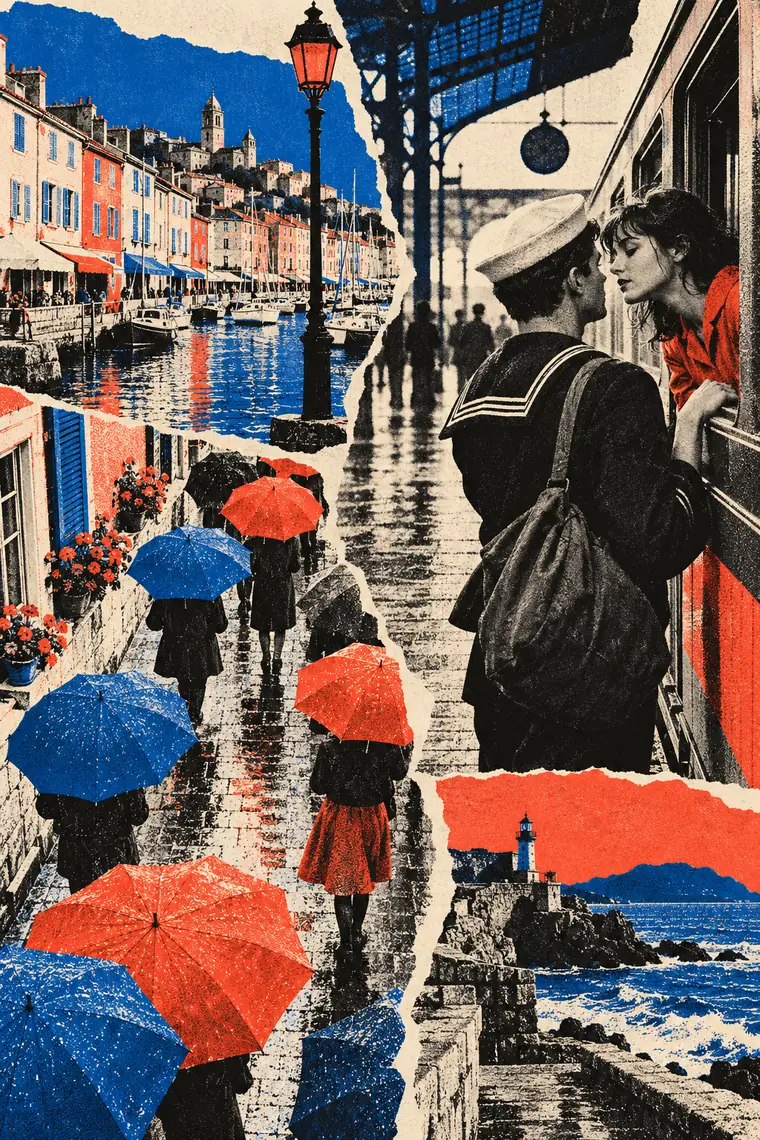
Les Parapluies de Cherbourg (The Umbrellas of Cherbourg) is Jacques Demy's 1964 musical in which every line of dialogue is sung, from declarations of love to remarks about car repairs. Geneviève, a seventeen-year-old who helps her mother in an umbrella shop in Cherbourg, is in love with Guy, a young mechanic. He is called up for military service in Algeria, she finds she is pregnant, and the gentle, wealthy jeweller Roland Cassard offers her mother a solution. Michel Legrand's score, the candy-coloured sets and Catherine Deneuve's first major role make it look like a sweet. It is in fact one of the saddest films about how ordinary life wears love down. It won the Palme d'Or at Cannes in 1964.
A story in three parts
The film is divided into three parts, The Departure, The Absence and The Return, dated from November 1957 to December 1963.
In the first, Guy and Geneviève plan to marry, against the wishes of her mother, Madame Emery, who thinks they are too young and is worried about debts on the shop. Guy lives with his ailing aunt Élise and her quiet carer Madeleine, who loves him without saying so. Then his call-up papers arrive. Their last evening together, and the farewell on the station platform, are where Legrand's main theme is first heard in full.
In the second part, Guy's letters are rare. Geneviève is pregnant and lonely. Roland Cassard, who was rejected in love years before, falls for her and asks for her hand, ready to raise the child as his own. In the third, Guy comes home, wounded and bitter, to a town that has moved on without him.
Every word sung
Demy wrote the whole text as a libretto and Legrand set it to music, mostly in a jazz-tinged, conversational style rather than separate songs. The actors mimed to recordings by singers: Deneuve's voice is that of Danielle Licari. After a few minutes the strangeness disappears and the singing feels like the most natural way for these people to speak.
The main theme, known in English as I Will Wait for You, became a standard and was nominated for an Academy Award.
Colour
Demy and his designer Bernard Evein repainted shopfronts and streets in Cherbourg, and covered the walls of interiors with wallpaper in pinks, greens and blues that echo or clash with the costumes. Geneviève's dresses often match the wallpaper behind her. The effect is stylised and joyful, which makes the sadness of the story stronger.
Deneuve
Deneuve was twenty when the film came out. Her performance moves from youthful certainty to resignation, almost entirely through her face and posture, since the voice is not hers. The film made her an international star, and Demy cast her again with her sister Françoise Dorléac in Les Demoiselles de Rochefort (1967).
Roland Cassard is a character Demy had already used in his first feature, Lola (1961), where he was also played by Marc Michel and was turned down by Lola. Demy liked to link his films in this way.
The ending
Without giving anything away: the final scene, at a petrol station in the snow on Christmas Eve, is one of the most quietly devastating endings in cinema, played without a single dramatic gesture.
This is the best introduction to Demy and to French musicals. For other romantic films, see our selection of French love stories; for the decade, the best French films of the 1960s.