War drama · 1937 · France
La Grande Illusion 1937
Directed by Jean Renoir. Known in English as The Grand Illusion.
- DirectorJean Renoir
- Running time114 min
- CountryFrance
- Decade1930s
Review by Eleanor Hale
La Grande Illusion is Jean Renoir's 1937 film about French officers held in German prisoner-of-war camps during the First World War. There are no battle scenes. The film is about what links and divides people: class, nationality, religion, language. A working-class mechanic (Jean Gabin), an aristocratic career officer (Pierre Fresnay) and the son of a Jewish banking family (Marcel Dalio) plan escapes together, while the German commandant (Erich von Stroheim) feels closer to his aristocratic French prisoner than to his own men. The title comes from a 1909 book by Norman Angell arguing that war no longer made economic sense. The film was a huge success in 1937, was banned in Nazi Germany, and remains one of the most humane war films ever made.
From one camp to another
Lieutenant Maréchal, a mechanic in civilian life, and Captain de Boeldieu, an officer from an old family, are shot down on a reconnaissance flight and taken prisoner. In the first camp they share a hut with a group of Frenchmen who are digging a tunnel, among them Rosenthal, whose family sends lavish food parcels that he shares with everyone. The prisoners stage a revue in women's clothes; in the middle of it, news arrives that the French have retaken Douaumont, and they stand up and sing the Marseillaise in front of their guards.
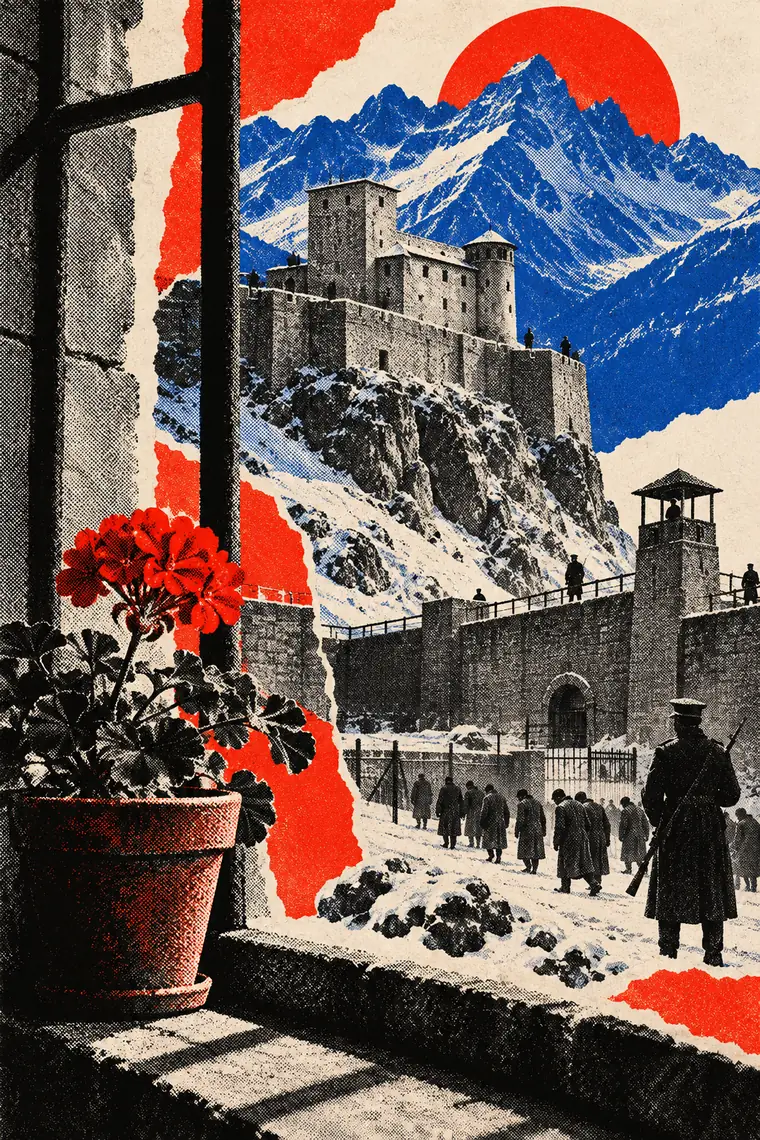
Before the tunnel is finished, they are moved. After many transfers, Maréchal, Boeldieu and Rosenthal end up in a mountain fortress run by Captain von Rauffenstein, a former pilot crippled in a crash, who wears a neck brace and white gloves.
The two aristocrats
Rauffenstein and Boeldieu speak English together so the others cannot follow. They share a code of honour and the sense that their class is dying, and that the war is finishing it off. This relationship is the heart of the film. Boeldieu ends up making a choice that puts loyalty to his fellow prisoners above loyalty to his caste, and Rauffenstein is left alone with a geranium, the only flower in the fortress.
Maréchal and Rosenthal
The second part follows the two escapees across the German countryside in winter. Exhausted and hungry, they quarrel; Maréchal says something cruel about Rosenthal being Jewish and then comes back for him. They shelter on the farm of Elsa, a German war widow played by Dita Parlo, and Maréchal and Elsa fall in love without a shared language. Renoir gives this episode a tenderness that makes the frontier at the end of the film look absurd.
How Renoir films it
Renoir often lets the camera move through a room in long takes, so that we see several groups of characters at once and the background stays alive. The prison scenes are full of small details of daily life: laundry, lessons in German, the gramophone, the arguments over food. Nobody is a villain. Even the guards are tired men a long way from home.
Von Stroheim, the Austrian-born Hollywood director and actor, was cast late, and Renoir enlarged his role. His stiff, sad Rauffenstein became one of the great screen performances of the 1930s.
The film's afterlife
La Grande Illusion was banned in Germany and Italy. Its original negative was taken to Germany during the occupation of France and was long thought lost. It turned up in the Soviet Union's film archive after the war and was eventually returned to France, which allowed a proper restoration in the 1990s.
It is the best way into Renoir's work, before the harder and stranger La Règle du jeu. For other films of the decade, see the best French films of the 1930s, and for more films about war, our best French war films.