Fantasy comedy · 1952 · France, Italy
Les Belles de nuit 1952
Directed by René Clair. Known in English as Beauties of the Night.
- DirectorRené Clair
- Running time87 min
- CountryFrance, Italy
- Decade1950s
Review by Eleanor Hale
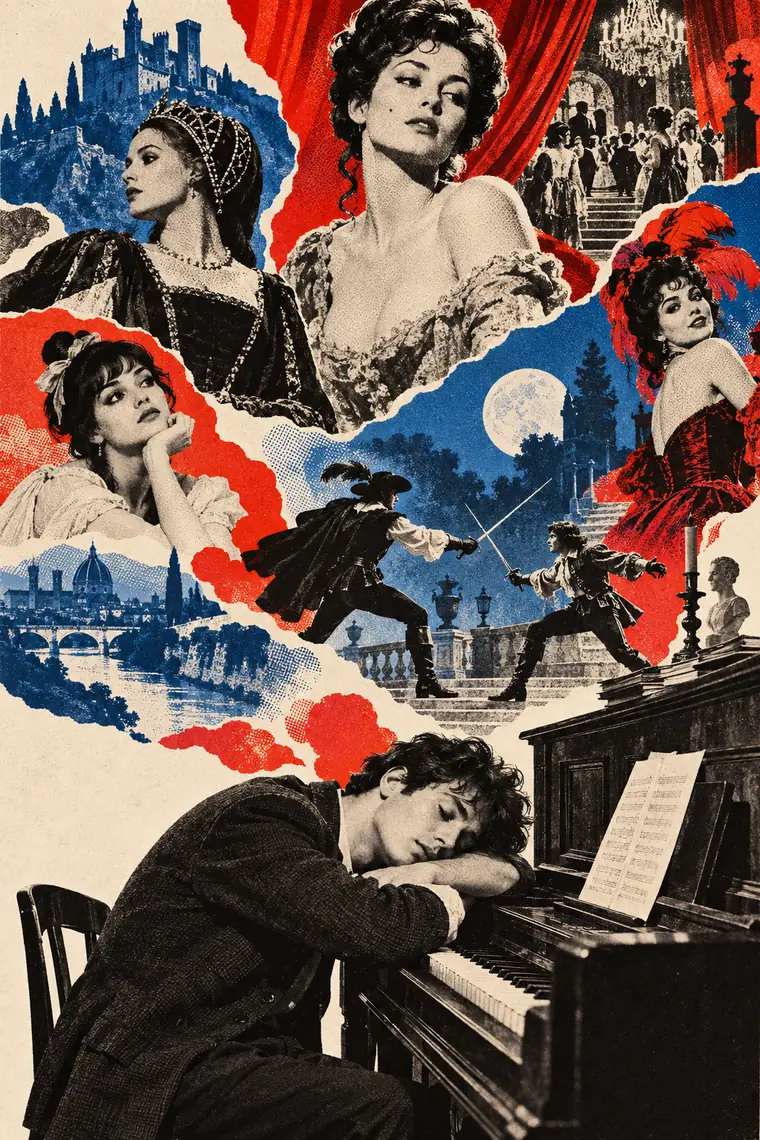
Les Belles de nuit (Beauties of the Night) is René Clair's 1952 fantasy comedy about Claude, a poor young piano teacher and composer in a small French town, who escapes from his dull, noisy daily life into dreams. In them he is a celebrated musician and a seducer of beautiful women in earlier times, each dream taking him further back into the past. Each dream begins pleasantly and ends with him pursued by jealous husbands, fathers and soldiers, and soon he is afraid to fall asleep. Gérard Philipe plays Claude, with Martine Carol and Gina Lollobrigida among the women of his dreams. It was nominated for the Golden Lion at the Venice Film Festival and drew three and a half million spectators in France. It is light, quick and very funny.
A composer who cannot work
Claude lives in a provincial town where nothing goes right. His pupils are hopeless, his opera goes unheard, and the noise of the street and the neighbours keeps him from composing. The friends he talks to, the mechanic Roger, the pharmacist Paul, the gendarme Léon, the postman, are no help, and an old gentleman keeps repeating that things were better in his day.
That refrain is the key to the film. Each time the past is praised, Claude's dreams take him further back, and each time he finds that the past was no better at all.
The dreams
In the dreams, the people of his waking life reappear in other roles. A cashier becomes Leila, played by Gina Lollobrigida. Martine Carol plays Edmée. A postal clerk becomes Madame Bonacieux, the heroine of Dumas. Suzanne's father turns up as a marquis. The town's men return as husbands, brothers and officers.
Clair cuts between the periods with growing speed, and in the last part of the film Claude rushes from one century to another, chased by the past itself, while trying desperately to stay awake. The rhythm is close to the farces of the silent era, where Clair began.
René Clair's fantasy
Clair had made his name with comedies that mixed realism and whimsy, such as Sous les toits de Paris and Le Million. After returning from Hollywood he made several films with Philipe, of which this is the most playful. It was shot at the studios in Boulogne. Georges Van Parys wrote the score, which matters here more than in most films, since Claude's music runs through the dreams.
Suzanne
The real heroine is not one of the dream women but Suzanne, Claude's young neighbour, played by Magali Vendeuil, who resembles a woman from one of his dreams. The film's gentle moral is that what you are looking for may be next door, in the present.
Is it for you?
If you enjoy comedies with a fantasy premise, it is a delight, and it is short. Its view of women as prizes in a young man's dreams is of its time, though the film also mocks Claude's daydreams.
Clair and Philipe worked together again three years later on the more serious Les Grandes Manœuvres. See also the best French fantasy films and the best French comedies.
More films to see next
 Romantic comedy-dramaLes Grandes ManœuvresRené Clair · 1955
 Crime thrillerCet homme est dangereuxJean Sacha · 1953
 ThrillerLe Salaire de la peurHenri-Georges Clouzot · 1953
 Psychological thrillerLes DiaboliquesHenri-Georges Clouzot · 1955
 Prison dramaUn condamné à mort s'est échappéRobert Bresson · 1956